Showing posts with label drawing with fountain pens. Show all posts

Friday, 24 June 2022

My favourite all-round fountain pen

I've used fountain pens for writing and sketching since I was a teenager. I go into a lot of detail about them in my Travel Sketching Course, where I devote a whole lesson to their use, and have written a number of blog posts about these gorgeous tools. What I most often get asked is 'what would my recommended pen for sketching if money were no object'. Now - pen prices can go sky high and my collection is more about utility than collectability so I haven't really explored the amazing decorative pens in lacquer, gold and other precious metals that are available. Compared to those, my pens are quite humble. However I do prefer a gold nib, which raises the price, but I love the smooth writing experience that a gold nib provides. 
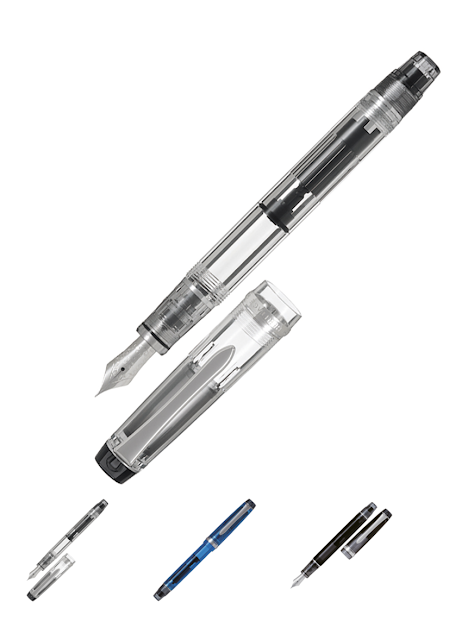
Pilot Custom Heritage 92 (photo from pilot pen.com.au)
The other characteristics that I enjoy are large ink capacity and comfort in the hand. 

I prefer that the pen is not too thick and not too heavy so it can be comfortable to draw with for many hours. 

The Pilot Custom Heritage 92 is just such a pen. I use the F nib in this pen, which gives a fine line with a little flex, but no scratch. While lovely for drawing and sketching, it is also a pen I enjoy writing with. 

It is only available in the clear, the smoky black and the blue models as shown, and I have one of each that I ink up in different colours, usually Brown, Grey and a light grey. It has a piston feed rather than a converter, and a large 1.2ml ink capacity. The pen is comfortable to use with the cap posted or not.


Pilot also makes a custom Heritage 912 that looks similar, but it comes in solid black and has a converter. It is the Pilot CON-70 converter that has a plunger for easy filling, and holds up to 1.1ml of ink. If the Con-70 vac converter appeals, there is also the more rounded body of the Pilot Custom 743 and Pilot Custom 74 to consider. 

Right now, Larrypost in Australia is offering a range of fountain pens at fantastic prices as we approach the end of our financial year. Other great pen sites are Gouletpens.com and Jetpens.com - which specialises in Japanese pens.

I really enjoy Pilot pens. I use the E95s in my diary for everyday writing, and love the Pilot Falcon pens that I wrote about in another post. 

While I almost always use pens in my sketches, I also often use fountain pens in my larger paintings. In this work, completed earlier this year, I drew using the Pilot Custom Heritage 92 pens inked in De Atramentis Document Ink in lighter and darker greys, and painted with watercolour in Jane's Grey and Jane's Black with a very little raw umber and burnt sienna for colour. This mixture of techniques combines my two great loves - drawing and painting.

'Grounded' - ink and watercolour on paper

Other wonderful Japanese pen brands include Sailor, Pelican and Platinum - which I think has the finest nibs available in an UXF (Ultra Extra Fine). While I haven't used Pelican or Platinum at all myself, I do love the super fine EF nibs of my Sailor pens for when I want to draw in really fine detail.

I've posted a number of articles about fountain pens, which I use for writing as well as drawing and sketching. I'll add the links here for convenience.

Favourite pens for sketching (originally 2015, updated 2019, soon to be updated again as some models have changed.) 

Lamy pens 2015 - great pens for writing and sketching 

TWSBI Diamond 580 2018 - huge ink capacity 

My Sketching Tools 2019 shows some other pens too, including the Pilot Heritage Custom 92 that I'd like to talk more about here.

For more on inks for sketching in fountain pens, check my other blog posts.

Packing inks and pens 2015

Fountain Pen and Drawing Inks 2014

Fountain pen inks 2018

Working in Ink 2014

De Atramentis Inks Revisited 2018 (with numerous links to posts about mixing coloured inks)

Happy drawing :-)

Sunday, 11 March 2018

TWSBI Diamond 580 fountain pen

The TWSBI Diamond 580AL filled with Sailor Storia Lion ink
For all I love fountain pens, one of the frustrations of using them is that they run out of ink. So do other pens of course, eventually (and they get thrown away) but fountain pens need to be refilled regularly, especially if using them for sketching and cross-hatching!

I carry small Nalgene bottles of ink with me when travelling or sketching so I have some on hand, but I've long been curious about the TWSBI pen as it has a massive (2ml according to their literature) ink capacity. I am using the TWSBI Diamond 580AL which is the largest of the series with the largest ink capacity. The Diamond 580 is identical, except that some of the parts that are metal in this pen are plastic in the 580 version, so it is perhaps 25% lighter.  It also comes in a mini version that is shorter and slimmer.

It's available in Australia from Larrypost, who specialise in all things pen, sketchbook, watercolours and ink. In the US I'd recommend Gouletpens.com. I filled the pen with a sample of Sailor Storia 'Lion' ink, a lovely golden brown ink, also from Larrypost. This is a pigmented ink so is fairly waterproof - an important consideration when sketching with watercolour. I wanted to use a fairly light colour to do the sketch for this sandstone building in Pyrmont. You can see the large capacity of this piston filling pen that works without a cartridge or converter.

Drawing with Sailor Storia Lion ink and the TWSBI Diamond 580

I have the Extra Fine nib, which always my preference as I really like fine lines. This is a Taiwanese pen with German nibs, so the Extra fine is not as fine as my Japanese EF nibs, but it is a really nice line width for writing or drawing - very like the Lamy. You can see how light the sandstone is in this picture, and why a black ink or even my usual dark brown or grey, would have been too strong.


Completed with watercolour, the initial line-work almost disappears.
Union Street, Pyrmont, ink and watercolour.

I wanted to test out this pen for other purposes too so I've filled it with black De Atramentis Document ink - my go-to ink for drawing with fountain pens. I'll give it a run with the black ink in my diary and sketches and see how it goes.

The TWSBI pen is also available with a gorgeous ink bottle that has a two-lid system containing a very clever filling mechanism. You can fill the pen without getting your hands covered in ink! You take off the top part of the bottle and the nib from the pen and fill the body from the beautiful and cleverly designed bottle. The special filling mechanism works with the TWSBI Diamond range, the TWSBI Classic range and also with the 'universal' converter so it is really nifty! Of course you can use fill any other pen from the bottle in the usual way.

The TWSBI Diamond 580 pen and the Diamond 50 ink well.
It is heavier (28grams) than some of the other fountain pens I've used, and quite thick in the barrel so it doesn't easily fit in the pen loop of my dairy. I usually use a Lamy Joy as it slots in very nicely. So I am keeping this one in a pencil case in my handbag.

I wasn't sure whether I like the lid posted or not - it is heavier than the Joy posted but feels shorter un-posted. It is not strictly designed to 'post' - it sits on the turning screw that is used to fill and empty the pen rather than fitting fully over the barrel of the pen. The Mini version, however, does post normally. The Classic version doesn't post at all. Of course I don't post the Lamy Joy nib, but I often do with other pens. It's all about the weight and balance of each pen.

Lines made with a Lamy and a TWSBI, both EF nibs.
I ended up using it un-posted most comfortably when I took it out sketching on Saturday and gave it a proper run. It is a robust nib, not intended as a flexible nib, but there is a bit of line variation possible - press lightly and get a very fine line, press more firmly and get a darker and thicker line. Turning the nib upside-down also gives a fine line but any finer so I didn't really bother doing that with this pen. It ran very smoothly with the De Atramentis ink and I enjoyed working with it. It certainly didn't come anywhere close to running out of ink! And that is the big feature of this pen - ink capacity. If you write and draw a lot, it's hard to beat. Interestingly is also coped very well with the medium texture of this watercolour paper. The EF Japanese nibs such as my Sailor 1911 EF can struggle since they are so fine.

A Moreton Bay Fig and Wendy Whiteley's Secret Garden, Lavender Bay, drawn with the TWSBI Diamond 580 pen and De Atramantis Document Black ink. The paper is Fabriano Artistico.
November 2018 edit - TWSBI also make an Eco pen, which is almost the same to look at initially, but has a lightly narrower nib and is made with different plastic and without the 'diamond' stying; and the newly introduced Go, which is a spring filled pen at a very low cost. I'd recommend looking at the Eco as an excellent starter fountain pen for sketching. It is also lovely to write with. I'll add a blog post soon.

I'll be taking the Kaweco for a spin at some stage. I do love drawing with fountain pens :-)

For more on fountain pens see Lamy here, My Favourite Pens for Drawing here and Working in Ink here. There are also many posts on mixing inks on this blog - just use the search tool :-)